Sleep Materials · Standards Guide
What Organic Certifications Reveal About Sleep Materials
A label can offer a useful trail through the complicated landscape of mattress materials—but it is not a shortcut to knowing how a bed feels, how long it will last, or whether every component meets the same standard. Learn what organic certifications can verify, where their boundaries lie, and how to read claims with care.
Published October 29, 2026
At first glance, a mattress seems like one object: a calm, level horizon at the center of the bedroom. In reality, it is a layered landscape. Fibers are spun into yarn, yarns become fabrics, and padding, foam, latex, springs, adhesives, and covers may be assembled into a single sleep surface. A certification printed on a label can describe one of those layers—or, under some standards and circumstances, a broader portion of the finished product.
That distinction matters. The word “organic” is not a universal technical description that automatically applies to every part of a mattress. Standards differ in what they cover, how they trace materials, and whether they assess processing, chemical inputs, social criteria, or finished-product composition. A thoughtful reader asks not only whether a product is certified, but what is certified, by whom, and according to which standard.
For people comparing organic mattresses or bedding, certification can make material claims easier to evaluate. It can provide documented evidence about fiber sourcing and processing rather than relying entirely on broad marketing language. Yet it does not predict whether a mattress will suit a person’s body, sleeping position, temperature preferences, or budget. It is one instrument in a larger field of judgment.
What an organic label can—and cannot—tell you
Certification is a system of rules and verification. A standard defines requirements; an independent certifier or authorized body checks whether those requirements have been met. Depending on the program, this may involve examining records, reviewing supply-chain documentation, assessing facilities, or testing materials. The exact process and scope vary, so the name of the standard is more informative than a vague claim alone.
For textile components, a certification may help establish that certain fibers came from certified organic agricultural production and that later stages of processing followed defined requirements. Some standards also address chemical use, wastewater, worker protections, or traceability. Others concentrate more narrowly on the amount of certified organic material in a product. These are different questions, and a label that answers one should not be assumed to answer them all.
Certification generally does not tell you how supportive a mattress is, whether its firmness will feel right, or how well it will retain its shape after years of use. It is not, by itself, a guarantee of comfort, durability, hypoallergenic performance, or environmental superiority in every respect. Nor does it mean that every item in the supply chain is free from every chemical or environmental impact. A standard has defined boundaries; careful interpretation begins by finding them.
GOTS and the textile layers of a mattress
The Global Organic Textile Standard, commonly known as GOTS, is a textile-processing standard with requirements that extend beyond the origin of the fiber. Its framework includes criteria for organic fiber content and for processing stages covered by the standard. It also includes environmental and social requirements within its defined scope. The standard is relevant to textiles such as cotton covers, ticking, and some other fabric components—but it should not automatically be read as a certification of every material hidden inside a mattress.
One practical implication is that a GOTS claim needs a precise subject. Is the cotton cover certified? Is a particular textile component certified? Is the finished article certified under the applicable product rules? The answer depends on the specific product and documentation. A mattress might combine a certified textile cover with other materials that have separate credentials or no organic certification at all. The certification of one layer does not magically extend to all the layers beneath it.
GOTS includes minimum organic-fiber content requirements for products making claims under its different labeling categories. The required percentage depends on the category and applicable version of the standard. Rather than relying on a retailer’s shorthand, look for the exact claim, the certification scope, and documentation that identifies the product or component. Standards can be revised, and the version in force at the time of certification may matter.
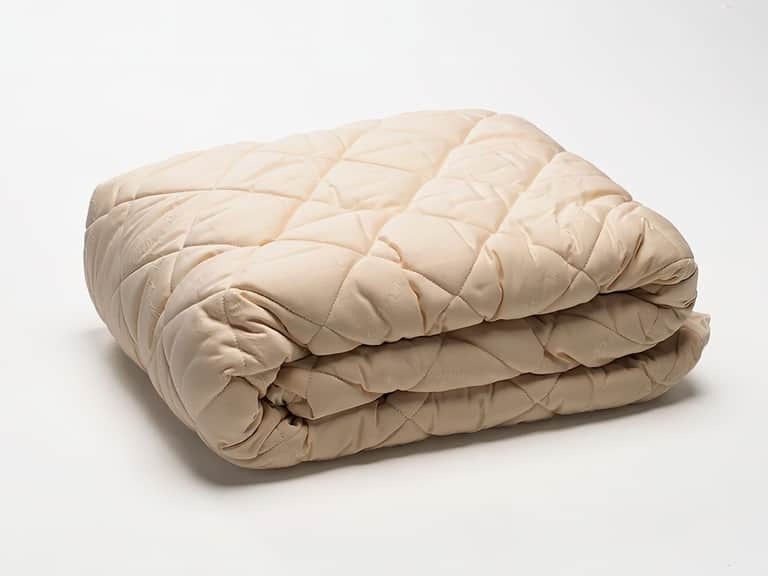
For example, a mattress pad may have a GOTS-certified cotton outer fabric while its fill is made from another material. That does not make the claim meaningless; it means the claim should be understood accurately. A washable wool mattress pad described as using certified organic cotton illustrates why readers should distinguish the cover, the filling, and the product as a whole. The relevant question is not simply “Is it organic?” but “Which component is certified, and what does the documentation say about the rest?”
Different standards answer different questions
GOTS is one recognizable certification in the textile landscape, but it is not the only mark readers may encounter. Other programs address organic fiber content, particular raw materials, chemical safety, or broader manufacturing practices. The names can sound similar while their purposes differ. A useful comparison starts by identifying the question each standard is designed to answer.
- Fiber origin: Does the standard verify that a named fiber comes from certified organic agriculture?
- Processing: Does it set requirements for dyeing, finishing, or other stages in the production chain?
- Content: Does it specify how much of the finished textile must be certified organic fiber?
- Supply-chain traceability: Does the program require records that connect material claims to the product being sold?
- Health or chemical criteria: Does it assess particular substances or emissions, and at which stage?
- Social and environmental practices: Are these included, and what parts of the supply chain fall within the assessment?
For latex, readers may encounter standards that focus on organic latex materials, while textile certifications may apply to the cotton cover or other fabric elements. These are not interchangeable claims. A mattress could have certified organic cotton and a separately certified latex component, or it could have one certified component and others that are described only by material type. Product documentation should make those distinctions visible.
Likewise, words such as “natural,” “eco-friendly,” and “chemical-free” are not substitutes for a named, verifiable certification. “Natural” may describe a source or a marketing position without specifying a consistent test. “Chemical-free” is especially imprecise: all physical materials are made of chemicals, and responsible standards typically define restricted substances or processes rather than promising an impossible absence of chemistry. Specific claims are more useful than sweeping ones.
Read the product as a map of materials
Before comparing labels, break the mattress into its major components. The outer ticking may be cotton, wool, or a blend. Beneath it may sit batting, a comfort layer, a support core, springs, adhesives, and a base fabric. Each layer can have a different origin and a different documentation trail. A product description that names only the cover leaves much of the construction unexplained.
Make a simple inventory: list each material, its location in the mattress, and the claim attached to it. Is the cotton cover certified organic, or merely described as cotton? Is the wool identified by source and processing? Is the latex stated to be natural, certified organic, or a blend? Are synthetic materials used elsewhere? The answers can reveal whether a product’s sustainability story rests on one prominent component or on a more comprehensive set of verified materials.
Then look for product-level documentation. A brand may publish a certificate, a scope statement, or a certification number that can be checked through the relevant certification organization. Confirm that the document applies to the product, facility, or component being discussed—not simply to the company in general. A certification held by a supplier does not necessarily prove that every finished product sold by a retailer carries the same status.
When details are missing, a concise question to the manufacturer can be revealing: Which parts of this mattress are certified, under which standard, and can you provide documentation for this model? A clear response should distinguish component-level certification from finished-product claims. It should also avoid implying that one label covers materials outside its scope.
Certification is not a comfort test
Organic credentials and sleep performance describe different dimensions of a mattress. A certified cover does not establish that the bed will keep a particular sleeper cool. A certified fill does not determine pressure relief, spinal alignment, edge stability, or ease of movement. Those qualities arise from the complete construction and from the interaction between the mattress and the person using it.
Comfort is also personal. Body weight, sleeping position, mobility, pain history, and temperature preference can all influence how a mattress feels. A surface that seems gently yielding to one sleeper may feel too soft to another. Even a well-documented material profile cannot replace a careful assessment of support and fit. If possible, consider the maker’s trial and return terms, warranty conditions, and guidance for evaluating a mattress at home.
Durability deserves its own investigation. Ask about the density or construction of foam where relevant, the quality and design of the support system, the resilience of natural latex, the way upholstery layers are secured, and the care instructions. Certification may contribute to confidence about a material’s sourcing or processing, but it does not automatically predict how a mattress will perform over time.
It is also important to separate material claims from health promises. A certification can establish compliance with a defined standard; it does not prove that a product will prevent allergies, cure pain, or improve sleep for every person. People with particular sensitivities may want to review the full materials list and seek appropriate professional advice when health concerns are involved.
A practical checklist for evaluating organic mattresses
In a market crowded with seals, adjectives, and finely printed claims, a repeatable method can help keep comparisons grounded. Use this checklist as a starting point rather than a scorecard that treats every certification as identical.
- Name the material. Identify the exact fiber or substance the claim concerns—such as cotton, wool, or latex.
- Locate the component. Determine whether the claim applies to the cover, a filling, the core, or the entire finished product.
- Identify the standard. Look for the full certification name, not only a general “organic” statement.
- Check the scope. Read what the standard covers and which stages or materials it excludes.
- Seek documentation. Look for a certificate, scope document, or verifiable certification reference tied to the product or relevant facility.
- Separate claims. Keep sourcing, processing, chemical, environmental, and social claims distinct; one does not prove all the others.
- Evaluate the whole mattress. Review construction, support, care, durability, and fit alongside certifications.
- Compare like with like. A certified textile cover and a certified latex core are different claims; avoid treating their labels as equivalent.
This approach is useful for bedding as well as mattresses. Sheets, mattress pads, pillow covers, and other textiles may each carry claims that apply to different fibers or manufacturing stages. In a sleep system assembled from several products, it is entirely possible for one component to be certified while another is not. That is not necessarily a flaw; transparent boundaries are more informative than an undifferentiated promise.
How to interpret uncertainty
Supply chains are rarely simple. A cotton fiber may pass through farms, gins, spinners, mills, dyers, and sewing facilities before becoming a mattress cover. The finished mattress may then bring together components from still more sources. Certification systems attempt to make parts of this journey verifiable, but they do not erase complexity. Their value lies in defined rules and documented accountability—not in the suggestion that every question has been answered.
When a claim is unclear, resist the temptation to fill in the gaps. “Made with organic cotton” does not necessarily mean every textile in the product is organic. “Certified organic materials” is incomplete without knowing which materials and which certification. “Tested for harmful substances” should be accompanied by the name and scope of the test or standard. Specificity is a sign of useful communication; ambiguity is a reason to ask for more information.
There may be trade-offs, too. A mattress with more documented natural or organic components may still differ in feel, care needs, price, weight, or suitability from another option. Some materials require particular maintenance; some covers are not removable or washable. A responsible decision weighs the material story against practical conditions in the bedroom and the needs of the sleeper.
A label is a starting point, not the destination
Organic certifications can illuminate parts of a mattress that are otherwise hidden beneath its surface. They can help readers compare fiber sourcing, processing requirements, and the reach of product documentation. GOTS, for example, can provide meaningful information about qualifying textile components and the stages within its scope. But no single seal should be treated as a complete portrait of a mattress.
The most reliable evaluation brings several kinds of evidence together: a clear materials list, a named standard, documentation that matches the product, an honest account of what is not covered, and practical information about support and care. This wider view keeps “organic” from becoming a stand-in for every quality a sleeper might value.
In the quiet geography of the bed, materials form a layered terrain. A certification is a marker on that map—not the entire landscape. Read it closely, follow the claim to the component it describes, and then consider the mattress as a whole. That is how a label becomes useful: not as a promise of perfect sleep, but as a verifiable piece of information in a more informed choice.
Key takeaways
- Certification standards differ in scope; always identify the exact standard and claim.
- GOTS applies to qualifying textiles and defined processing stages, not automatically to every mattress component.
- Component-level certification should not be confused with certification of a finished mattress.
- Organic credentials do not guarantee comfort, durability, health benefits, or environmental impact in every respect.
- Use documentation, construction details, support needs, care requirements, and personal fit together when evaluating sleep materials.